
Behavioral Health Insurance Verification: A Simple Guide for Mental Health & Substance Use Disorder Providers
Struggling with behavioral health claim denials? Discover why standard EV/VB checks fail for Mental Health & Substance Abuse.
By Ambit Behavioral Health TeamAmbit
The Hidden Revenue Leak Every Behavioral Health Provider Must Address in 2026
Demand for Mental Health (MH) and Substance Use Disorder (SUD) treatment has reached an all-time high. Expanding access to care is top of mind for clinical leaders, yet back-office operations are facing an increasingly complex administrative landscape.
While organizations rightly prioritize clinical outcomes, many underestimate the silent revenue killer hiding in plain sight: flawed front-end insurance verification.
A single oversight during the intake process can trigger a chain reaction of behavioral health billing friction — from immediate claim denials and authorization clawbacks to patient dropouts caused by surprise billing. For organizations delivering behavioral health services across diverse settings — including outpatient therapy, Intensive Outpatient Programs (IOP), Partial Hospitalization Programs (PHP), residential treatment, detoxification, Medication-Assisted Treatment (MAT), psychiatric care, and Telehealth — insurance verification is no longer a simple front-desk checklist item.
It is the single most critical foundation of your entire Revenue Cycle Management (RCM) strategy.
Why Standard Eligibility Checks Miss 80% of Denials
Checking eligibility for behavioral health is fundamentally different from standard medical billing and verification processes. In general medicine, an electronic clearinghouse query often returns a straightforward answer: active coverage, primary copay, and annual deductible status.
In behavioral health, a basic “green light” from a clearinghouse means virtually nothing.
Behavioral health eligibility involves navigating a web of separate administrators, carve-out plans, clinical necessity criteria, and restrictive authorization windows.
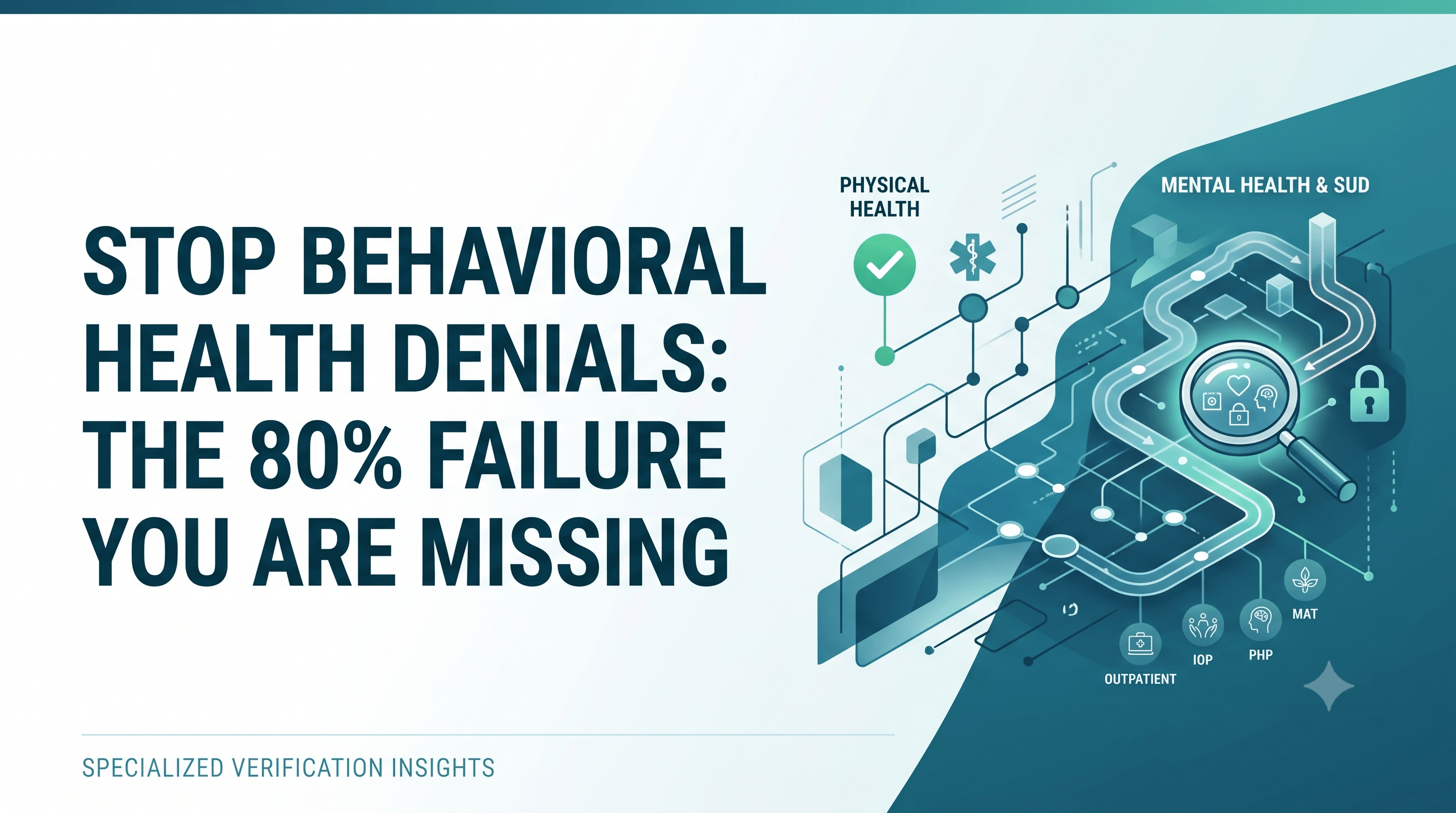
- Split Payer Structures: A patient’s physical health may be covered by a commercial payer, but their mental health or substance use benefits are often “carved out” to a third-party Managed Behavioral Health Organization (MBHO).
- Varying Level-of-Care Mandates: Benefits differ radically depending on whether the service is outpatient therapy, structured day programming (PHP/IOP), or 24/7 residential care/inpatient.
- Prior Authorization Confusion: Active eligibility does not equate to authorization. Many behavioral health claims are denied after care is delivered because staff failed to identify authorization triggers tied to specific levels of care.
- Non-Quantitative Treatment Limitations (NQTLs): Payers routinely impose subjective medical necessity reviews, visit limitations, and strict concurrent review schedules that do not exist in standard physical health plans.
The Financial Impact of Weak Verification
How weak behavioral health verification compares to standard medical RCM
| Revenue Cycle Metric | Standard Medical | Behavioral Health (Poor EV/BV) | Financial Impact on Providers |
|---|---|---|---|
| In-Network Denial Rate | 5% – 9% | 18% – 22% | High cash flow volatility; predictable revenue becomes impossible. |
| Preventable Denials | ~50% | 82% – 85% | Vast majority of BH denials stem directly from front-end intake errors. |
| Days in A/R | 32 – 40 days | 55 – 75+ days | Capital is tied up in appeals, limiting facility growth and clinical hiring. |
Case Study: Restoring Revenue for a Multi-Location BH System
The Challenge: A multi-site behavioral health network operating Residential SUD, PHP, IOP, and Outpatient Mental Health services across three states was facing serious revenue friction. Despite steady patient admissions, the organization experienced an overall claim denial rate of 19.4% and days in Accounts Receivable (A/R) averaging 68 days.
An internal review revealed that the clinical staff was delivering exceptional care, but the intake team was relying on standard clearinghouse checks that routinely missed MBHO carve-outs and authorization deadlines.
The RCM Transformation Strategy: The organization partnered with a specialized Behavioral Health Revenue Cycle Management team to overhaul its front-end intake. The strategy focused on:
- Mandatory Two-Tier Verification: Standardized checking of both medical carriers and MBHO carve-out registries prior to intake.
- LOC-Specific Auth Protocols: Pre-certifications were aligned strictly with ASAM criteria.
- Monthly Accumulator Tracking: Re-verifying deductibles on the 1st of every month.
The Results: Within 90 days of implementation, primary eligibility denials fell from 19.4% to 4.2%, and Days in A/R decreased to 31 days. Front-office personnel reclaimed 30+ hours weekly, redirecting their focus entirely to patient intake and clinical support.
Best Practices for Behavioral Health Insurance Verification
- Enforce Upstream Verification: Complete 100% of benefit verifications before the patient arrives for their first appointment.
- Establish LOC Checklists: Build standardized verification templates tailored specifically to Outpatient, IOP, PHP, RTC, Detox, and MAT.
- Separate MH and SUD Rules: Audit benefits for Mental Health and Substance Abuse independently.
- Log Every Reference Detail: Always document the representative’s full name, direct contact extension, and call reference number.
Conclusion: The New RCM Equation
Maintaining a specialized, highly accurate verification process internally is becoming increasingly difficult for growing behavioral health practices. The administrative burden is significant. Front-desk personnel are forced to spend hours on hold with payers, track shifting clinical criteria, and navigate complex clearinghouses.
To eliminate these bottlenecks, leading behavioral health organizations are moving away from fragmented in-house processes. Instead, they are partnering with dedicated Behavioral Health Revenue Cycle Management (RCM) experts. By outsourcing the heavy lifting of eligibility verification, authorization management, claims scrubbing, and denial resolution to specialized teams, providers gain financial stability, reduce operational overhead, and ensure seamless patient admissions.
Keep reading
Related blogs
 Denial Management
A Practical Denial Management Playbook for Busy Practices
How to categorize denials, prioritize high-dollar claims, and close the loop so the same issues stop repeating.
Continue reading Credentialing
Credentialing Timelines: What Providers Should Expect
A clear look at enrollment steps, common delays, and how to keep new providers billable without revenue gaps.
Continue reading Behavioral Health
Behavioral Health Billing Basics That Reduce Write-Offs
Specialty coding, session documentation, and authorization habits that help psychiatry and therapy practices get paid cleanly.
Continue reading