
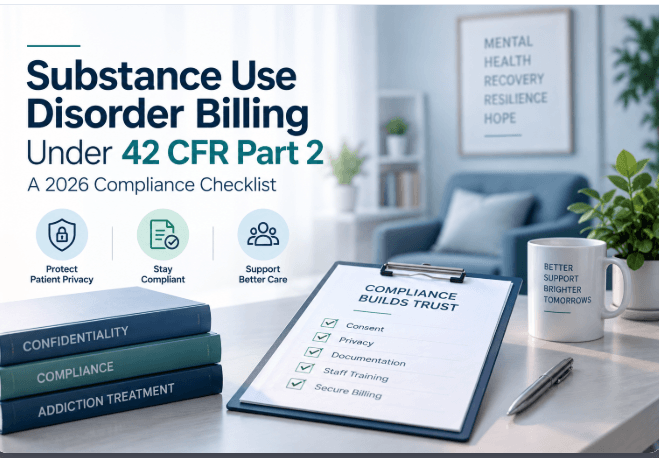
Substance Use Disorder Billing Under 42 CFR Part 2: 2026 Compliance Checklist
42 CFR Part 2 compliance is under active enforcement. Use this 2026 compliance checklist to verify consent, updated NPP, and SUD billing workflows before submitting claims.
By Ambit RCM TeamAmbit
If your organization treats patients for substance use disorders, 42 CFR Part 2 compliance is no longer something to prepare for later — the February 16, 2026 compliance deadline has passed, and HHS's Office for Civil Rights is now actively accepting complaints and running enforcement reviews. For billing and revenue cycle teams, this creates a specific kind of risk: Part 2 is a confidentiality and consent regulation, not a coding or reimbursement rule, but a documentation gap in your intake or billing workflow can still trigger an audit, a breach report, or a civil penalty. This 42 CFR Part 2 compliance checklist walks through what changed, what your billing team needs verified before a claim goes out, and where specialized Substance Abuse & Addiction Billing Services close the gap.
What 42 CFR Part 2 Actually Regulates (and What It Doesn't)
It's worth being precise here: 42 CFR Part 2 is a federal confidentiality law that protects records from any federally assisted program providing SUD diagnosis, treatment, or referral. It governs who can see a patient's SUD records and under what consent — it does not set CPT codes, reimbursement rates, or claims-submission rules. HHS's Office for Civil Rights is explicit that enforcement now runs through the same civil monetary penalty structure as HIPAA, with penalties reaching well into six figures per violation. That distinction matters for billing teams: you can submit a perfectly clean claim and still create a Part 2 violation if the consent or disclosure documentation behind it isn't in order.
Why SUD Billing 2026 Looks Different
SUD billing 2026 operates under active enforcement, not a grace period. As of February 16, 2026, anyone can file a Part 2 complaint with OCR, and covered entities, Part 2 programs, and their billing vendors are all in scope. For addiction treatment providers, that means eligibility verification, prior authorization requests, and claims correspondence involving SUD records now carry the same audit exposure that HIPAA violations always have. A missed consent update or an outdated Notice of Privacy Practices isn't just a paperwork issue anymore — it's a compliance finding waiting to happen.
42 CFR Part 2 Consent Requirements
The 2024 Final Rule replaced Part 2's old per-disclosure consent model with a single, unified consent that can cover treatment, payment, and health care operations (TPO) across HIPAA-covered entities and their business associates. Under the current regulatory text, that consent must still specify the recipient, expiration terms, and the patient's right to revoke it at any time. Every redisclosure made under that consent must include the required notice that Part 2 records can't be used against the patient in civil, criminal, administrative, or legislative proceedings without written consent or a court order. For billing teams, that means confirming a valid, current consent exists before any claim, authorization request, or eligibility check touches an SUD record.
Part 2 Notice of Privacy Practices: What Changed
Every Part 2 program, and every HIPAA covered entity that creates, receives, or maintains Part 2 records, must have an updated Notice of Privacy Practices that reflects the aligned rules. The NPP needs to be posted on your website and physically at the service location, and it must describe the enhanced protections that still apply to SUD records even after alignment with HIPAA. This is the same documentation layer we cover in our Behavioral Health Insurance Verification Guide — intake teams checking eligibility and benefits should be confirming NPP acknowledgment at the same time they're verifying coverage.
2026 Compliance Checklist
Use this as a working checklist to assess your current HIPAA Part 2 alignment 2026 posture, not as a substitute for a full compliance audit:
- Confirm whether your organization meets the definition of a Part 2 program
- Replace old per-disclosure consent forms with a single, unified TPO consent
- Add the required redisclosure prohibition notice to every SUD record disclosure
- Update your Notice of Privacy Practices and post it on your website and at your facility
- Review and update Business Associate Agreements with billing and RCM vendors
- Train front-desk and billing staff to verify consent before submitting claims or authorization requests
- Log every disclosure, consent, and revocation in a retrievable, auditable format
- Confirm your breach notification process meets the 60-day HIPAA timeline
- Revisit state-level substance abuse treatment billing rules, since some states layer additional consent requirements on top of federal Part 2
Where Billing Workflows Actually Break Down
In our work supporting addiction treatment billing compliance across multiple states, the compliance gaps we see almost never come from bad intentions — they come from billing and clinical documentation living in separate systems that don't reconcile. One multi-location SUD provider we supported had exactly this problem: front-desk staff were verifying insurance correctly, but consent forms were being filed in a clinical EHR that the billing team never checked before submitting claims. The fix wasn't more paperwork — it was a single intake checkpoint where eligibility verification, consent confirmation, and NPP acknowledgment happen together, the same workflow-first approach outlined in our Behavioral Health Billing Basics That Reduce Write-Offs guide. That single change closed most of the consent-related denials and audit exposure within a billing cycle.
Conclusion
Getting 42 CFR Part 2 compliance right isn't a one-time project — it's a workflow that has to hold up at intake, at claims submission, and at every reauthorization in between. Ambit Global Solution's substance abuse billing services build that workflow into your everyday billing process, so consent, documentation, and claims accuracy move together instead of in separate lanes.
Keep reading
Related blogs
Prior Authorization Interoperability Rules: What Behavioral Health Practices Must Prepare for Before 2027
Learn what CMS-0057-F means for behavioral health practices, including 2026 requirements, 2027 FHIR deadlines, authorization tracking, and compliance steps.
Continue reading
Navigating the 2026–2027 Midwife Billing Landscape: Regulatory Shifts, Coding Changes, and Revenue Strategies
How 2026–2027 CMS, global maternity, telehealth, and parity changes affect CNM, CM, and LM reimbursement — and how specialty RCM protects midwife revenue.
Continue reading
Provider Credentialing vs. Payer Enrollment: What Healthcare Practices Need to Know
Understand the difference between provider credentialing and payer enrollment, why both matter for healthcare billing, and how they impact revenue cycle management.
Continue reading