
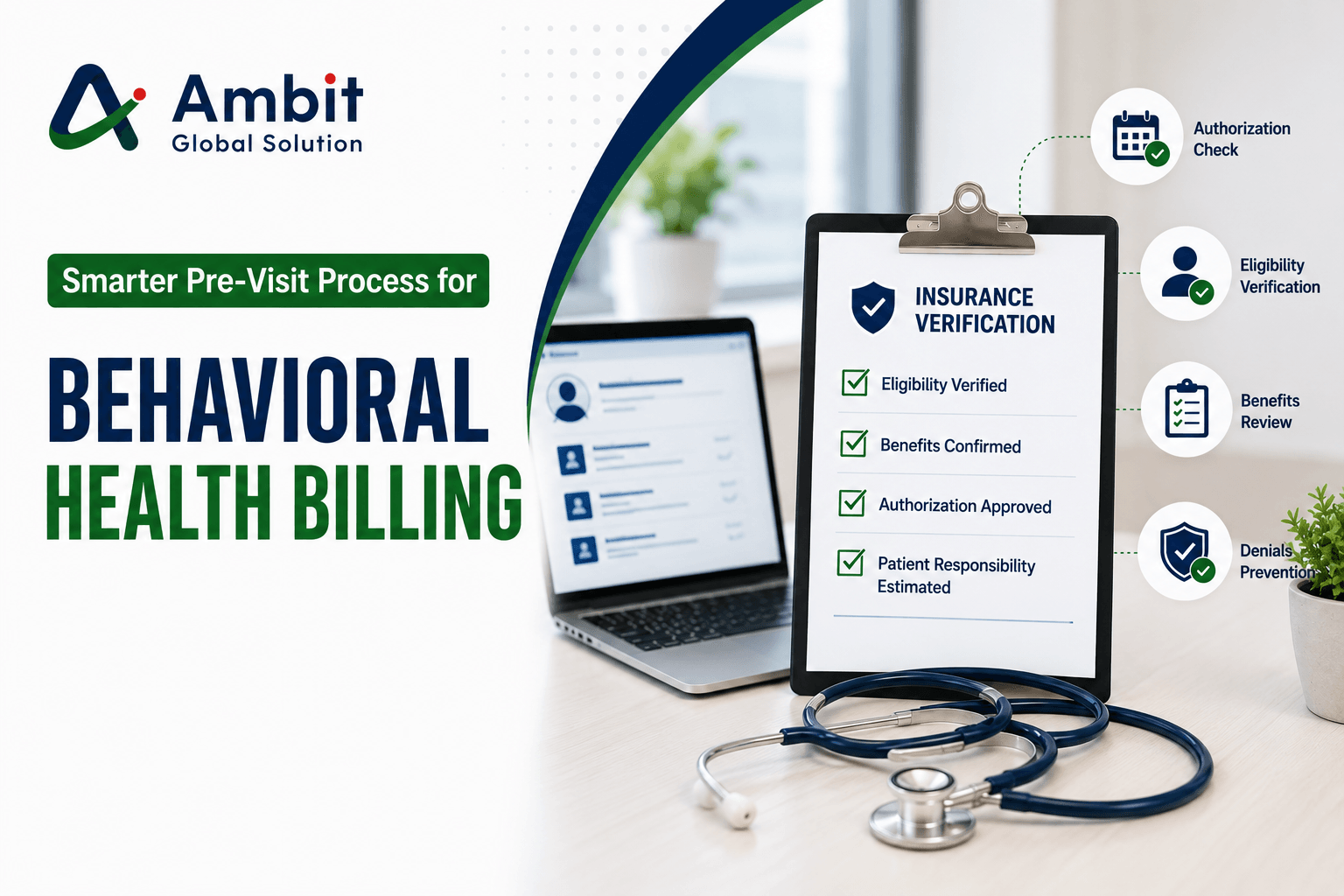
Smarter Pre-Visit Process for Behavioral Health Billing
Learn how a smarter pre-visit process helps behavioral health practices verify benefits, confirm authorization, prevent errors, and reduce claim denials.
By Ambit Behavioral Health TeamAmbit
Why Denials Begin Before the Session
A mental health or substance-use claim doesn't become clean only when it's submitted. Its likelihood of payment is often decided earlier, during scheduling, registration, insurance verification, authorization review, and pre-visit preparation.
When a practice learns after the appointment that the benefit is managed by another payer, the authorization has expired, the clinician isn't credentialed under that network, or the service has exceeded visit limits, the team is forced into reactive work: rework, delayed reimbursement, difficult patient conversations, and potential write-offs for care already delivered.
Behavioral health practices face added complexity because benefit structures, utilization-management rules, session-based services, and documentation expectations differ across payers. A stronger pre-visit process gives teams the chance to catch payment risks before the appointment, protecting clinician time and helping claims move with fewer disruptions. Effective behavioral health billing services start long before claim submission.
Active Coverage Is Not the Same as a Payable Service
Active eligibility only confirms enrollment on a given date. It doesn't confirm the planned service will be payable. Insurance eligibility verification is only the first step in confirming benefits.
For a service to be billed and paid correctly, coverage must be active on the date of service, benefits must exist under that plan, the clinician and location must meet network rules, the correct entity must administer the benefit, and any required authorization or visit limits must be addressed. This distinction matters most when mental health benefits are administered through a managed care organization or carve-out, since the primary medical plan may confirm enrollment but not handle benefits, authorization, or claims.
The practical question isn't "Is this patient insured?" but "Can this clinician provide this service, on this date, under this benefit, and submit it to the correct payer with the required authorization?"
The Six-Step Pre-Visit Workflow
1. Confirm Patient Identity and Active Coverage
Start with accurate registration: name, DOB, member ID, group number, plan name, subscriber details, and contact information. Request an updated insurance card at intake and whenever the patient reports changes.
Verify coverage for the actual scheduled date of service, and recheck according to your risk policy — before initial appointments, at the start of a new month, or before high-cost or authorization-dependent services. Document the verification date, source, staff initials, and any discrepancies. If eligibility can't be confirmed, define a clear next step: contact the patient, validate the member ID, contact the payer, or discuss self-pay options.
2. Verify Benefits and Patient Responsibility
Move beyond active insurance to confirm what the plan actually allows: covered service categories, in-network versus out-of-network rules, copay, coinsurance, deductible, visit or unit limits, referral requirements, and telehealth coverage.
Estimate and communicate patient responsibility before the appointment, without presenting estimates as guarantees. For ongoing care, set alerts for benefit thresholds and track remaining visits or units, watching for session limits that could trigger prior authorization denials. This step improves billing accuracy and helps reduce claim denials.
3. Identify the Correct Payer and Routing Path
Mental health benefits aren't always administered by the same payer managing general medical benefits. Confirm whether the service routes through the primary medical payer, a managed care organization, a Medicaid managed-care plan, or a carve-out administrator — and verify benefits and authorization directly with that administrator when a carve-out exists.
Document the routing path clearly: payer name, payer ID, provider-services contact, and authorization source. Proper routing prevents avoidable billing errors and is a core part of behavioral health revenue cycle management.
4. Confirm Authorization, Referral, and Utilization Requirements
Prior authorization requirements differ widely by payer, plan, service, and level of care. Where authorization is required, obtain and record the authorization number, approved service or level of care, approved CPT/HCPCS codes, effective dates, approved and remaining visits or units, and any clinician or facility restrictions.
A valid authorization must match the care actually delivered. Build a reauthorization calendar that flags upcoming expirations before the limit is reached. Strong prior authorization services rely on a consistent checklist, which strengthens denial management and gives the team a chance to resolve issues before the claim stage.
5. Align the Scheduled Service, Coding, and Documentation Plan
Confirm the expected service type and setting, clinician credentials, modality, applicable modifiers or place-of-service codes, and whether referral, authorization, or medical-necessity support is needed. Medical necessity documentation must support the claim.
For telehealth, verify current payer rules, since Medicare, commercial, and Medicaid requirements can differ. A pre-bill review before the appointment helps identify problems while there's still time to correct them.
6. Resolve Exceptions Before the Appointment
A pre-visit process only works if it tells the team what to do when something doesn't match. Common exceptions include unconfirmed coverage, a payer that differs from the medical plan, missing or expired authorization, exhausted visits or units, an unconfirmed network status, or unclear documentation requirements.
Each exception should have an owner, deadline, status, and documented resolution — not a vague note like "follow up with payer." When an issue can't be resolved beforehand, follow approved policy: reschedule, discuss self-pay, obtain patient acknowledgment, or escalate to an authorization specialist.
Common Failure Points and Prevention
Treating active coverage as proof of service coverage is a frequent error — use a verification template that separates enrollment, benefits, authorization, carve-out routing, and patient responsibility. Calling the medical payer alone can miss carve-outs, so add a required field for the benefit administrator and record claims-routing direction.
Letting authorizations expire creates avoidable denials; maintain a centralized tracker with alerts and one accountable owner per renewal. Resolving issues after care is delivered wastes resources — a daily-reviewed exception queue catches problems before the appointment. See how expired authorizations affect revenue in one of our related articles.
When Specialized RCM Support May Help
Consider a specialized RCM partner when eligibility checks are inconsistent, authorization requests are routinely delayed, claims go to the wrong payer or carve-out entity, or denials repeatedly point to authorization, eligibility, routing, or documentation gaps.
Ambit Global Solutions supports organizations with eligibility verification, authorization coordination, payer enrollment services, payer-specific workflow support, claims follow-up, and denial management — helping clinicians and practice leaders stay focused on patient care. See how this played out in our psychiatric billing case study and our Carelon reimbursement case study.
FAQ
Does active insurance mean a visit is covered?
No. Active enrollment doesn't confirm benefits, network status, cost-sharing, authorization, or the correct payer — confirm the details for the specific service and date.
Are benefits always billed to the medical payer?
No. Some plans administer behavioral health benefits through a separate MBHO or carve-out, and authorization or billing may need to go through that entity instead.
How early should a practice verify benefits and authorization?
As soon as the appointment is scheduled, with a recheck before the date of service and enough lead time to resolve issues before care begins.
Protect Revenue Before the Visit
The strongest denial-management strategy begins before a claim exists. When practices verify the correct benefit, identify the right payer route, confirm prior authorization, and resolve exceptions early, they reduce preventable friction across the revenue cycle.
Need help strengthening your pre-visit workflow? Contact our team to schedule a no-obligation RCM audit. Our billing and RCM support can help improve claims quality and reduce preventable denials.
Keep reading
Related blogs

What Independent Therapy and Psychiatry Practices Should Demand from Their Billing Partner This Year
If you own a solo or small-group therapy or psychiatry practice, raise your standards this year. Learn the specific coding, authorization tracking, and reporting you should demand from your billing partner.
Continue reading
Substance Use Disorder Billing Under 42 CFR Part 2: 2026 Compliance Checklist
42 CFR Part 2 compliance is under active enforcement. Use this 2026 compliance checklist to verify consent, updated NPP, and SUD billing workflows before submitting claims.
Continue reading
Prior Authorization Interoperability Rules: What Behavioral Health Practices Must Prepare for Before 2027
Learn what CMS-0057-F means for behavioral health practices, including 2026 requirements, 2027 FHIR deadlines, authorization tracking, and compliance steps.
Continue reading