Dental Billing vs Medical Billing: What Multi-Location Clinics Need to Know
Learn the key differences between dental and medical billing, including coding, claims, cross-coding, and RCM strategies for multi-location dental clinics.
By Ambit RCM TeamAmbit
Running a multi-location dental practice means managing more than patient care. Each location has its own claims, payer requirements, coding workflows, staff, and reimbursement challenges. When dental and medical billing processes overlap, those complexities can become even harder to manage.
Understanding the difference between dental medical billing and traditional dental billing can help practice leaders identify missed reimbursement opportunities, reduce avoidable claim denials, and create more consistent revenue-cycle processes across locations.
Dental Billing vs. Medical Billing: What's the Difference?
The biggest difference starts with the type of benefit being billed and the coding system used.
Dental claims commonly use CDT (Code on Dental Procedures and Nomenclature) codes to report dental procedures. CDT is the HIPAA standard for reporting dental procedures, while ICD-10-CM diagnosis codes may also be required depending on the claim and benefit being billed.
Medical billing typically relies on CPT or HCPCS procedure codes along with ICD-10-CM diagnosis codes to describe the service and the condition supporting medical necessity.
The claim formats can also differ. Dental services may be submitted electronically through the 837D transaction or on the ADA Dental Claim Form. Medical professional claims are generally submitted through the 837P transaction or CMS-1500 form.
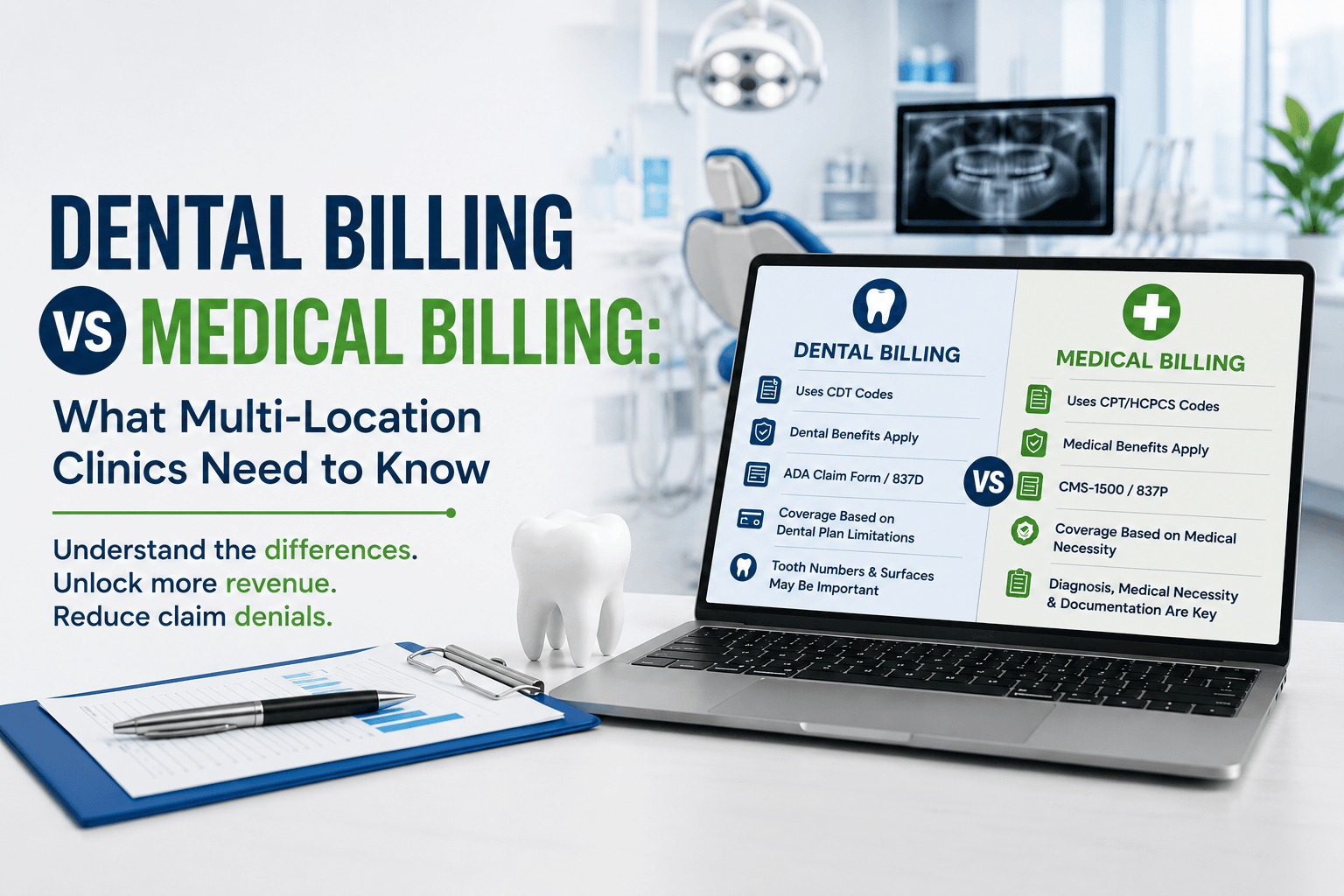
| Dental Billing | Medical Billing |
|---|---|
| Primarily uses CDT procedure codes | Primarily uses CPT/HCPCS procedure codes |
| Dental benefit rules apply | Medical benefit rules apply |
| ADA Dental Claim Form / 837D commonly used | CMS-1500 / 837P commonly used for professional claims |
| Coverage often depends on dental plan limitations | Coverage generally depends on medical necessity and medical plan benefits |
| Tooth numbers, surfaces, and oral anatomy may be important | Diagnosis, medical necessity, modifiers, and clinical documentation are often central |
The distinction matters because a claim can be correctly coded yet still be non-covered under a patient's particular plan. The ADA notes that having a valid CDT code does not mean a procedure is automatically covered or reimbursed.
When Can Dental Services Be Billed to Medical Insurance?
This is where medical cross-coding dental can create an additional revenue opportunity.
Cross-coding generally refers to billing medically necessary dental services to a patient's medical insurance when the service qualifies under the medical benefit. However, it is not simply a matter of replacing a CDT code with a CPT code.
The clinical circumstances, diagnosis, documentation, payer policy, and applicable coding requirements all need to support the claim.
For example, CMS currently recognizes circumstances in which certain dental services may be covered when they are integral to the clinical success of a Medicare-covered medical service. Examples include medically necessary dental treatment related to certain organ transplants, cardiac procedures, cancer treatment, dialysis, and other qualifying circumstances. CMS also requires appropriate documentation and coordination between medical and dental providers in applicable situations.
That means practices should evaluate the medical necessity and payer requirements before assuming a dental service belongs on a medical claim.
A strong dental medical billing workflow can help identify potentially eligible cases while maintaining appropriate coding and documentation standards.
Why Cross-Coding Can Matter for Revenue
For multi-location practices, missed medical-billing opportunities can occur when teams treat every service as strictly dental.
Some procedures or clinical situations may have a legitimate medical component. If the practice has no process for identifying those cases, verifying benefits, documenting medical necessity, and routing the claim correctly, potential reimbursement may be lost.
At the same time, aggressive or unsupported cross-coding can create compliance problems and increase dental claim denials.
The objective should therefore be accuracy—not simply maximizing reimbursement. The ADA advises that codes should reflect the services actually provided and should not be selected based on which code produces the highest reimbursement.
4 Multi-Location Dental Billing Challenges to Watch
1. Inconsistent workflows between locations
One location may verify benefits thoroughly while another relies on outdated information. Different processes can produce inconsistent claims, authorization gaps, and avoidable rework.
2. Coding knowledge varies by team
CDT, CPT, and ICD-10-CM requirements can be difficult to manage when billing teams have different levels of dental and medical coding experience. Cross-coding requires particular attention to documentation, payer rules, and the relationship between the diagnosis and service.
3. Denial trends are harder to identify
When each location manages its own billing process, leadership may not see recurring denial patterns across the organization. A payer issue affecting several locations can look like isolated problems when viewed one office at a time.
4. Reporting and accountability become fragmented
Multi-location practices need visibility into metrics such as clean-claim performance, aging, denial categories, collections, and outstanding A/R. Without standardized reporting, it becomes difficult to determine which locations need intervention and where revenue is being lost.
How Dental RCM Outsourcing Can Help
Dental RCM outsourcing can give growing practices access to standardized billing workflows and specialized revenue-cycle support without requiring every location to build the same capabilities internally.
An effective RCM partner can help coordinate eligibility and benefits verification, claim submission, payment posting, denial management, A/R follow-up, coding workflows, and reporting across locations.
The value is not simply having someone submit claims. It is having a consistent revenue-cycle process that allows leadership to identify problems earlier and make decisions using organization-wide data.
For multi-location practices, that centralized visibility can be especially valuable when payer requirements, staffing, and billing performance vary from one location to another.
Build a More Consistent Revenue Cycle Across Every Location
Dental and medical billing are not interchangeable processes. They involve different code sets, claim formats, coverage rules, and documentation requirements. But for practices that encounter medically necessary dental services, understanding where the two systems intersect can uncover legitimate reimbursement opportunities.
The key is having the right process to identify qualifying services, verify coverage, support medical necessity, submit accurate claims, and manage denials when they occur.
Ambit Global Solution works with multi-location practices to bring greater consistency and visibility to revenue-cycle operations. From billing and coding through denial management and A/R follow-up, our team helps practices build a more coordinated approach to revenue. Practices that treat patients across several disciplines can also draw on our broader specialty medical billing and coding experience.
Learn more about our End-to-End Revenue Cycle Management (RCM) or explore our Healthcare RCM and Medical Billing Services to see how a centralized revenue-cycle strategy can support your organization.
Keep reading
Related blogs

What Independent Therapy and Psychiatry Practices Should Demand from Their Billing Partner This Year
If you own a solo or small-group therapy or psychiatry practice, raise your standards this year. Learn the specific coding, authorization tracking, and reporting you should demand from your billing partner.
Continue reading
Substance Use Disorder Billing Under 42 CFR Part 2: 2026 Compliance Checklist
42 CFR Part 2 compliance is under active enforcement. Use this 2026 compliance checklist to verify consent, updated NPP, and SUD billing workflows before submitting claims.
Continue reading
Prior Authorization Interoperability Rules: What Behavioral Health Practices Must Prepare for Before 2027
Learn what CMS-0057-F means for behavioral health practices, including 2026 requirements, 2027 FHIR deadlines, authorization tracking, and compliance steps.
Continue reading